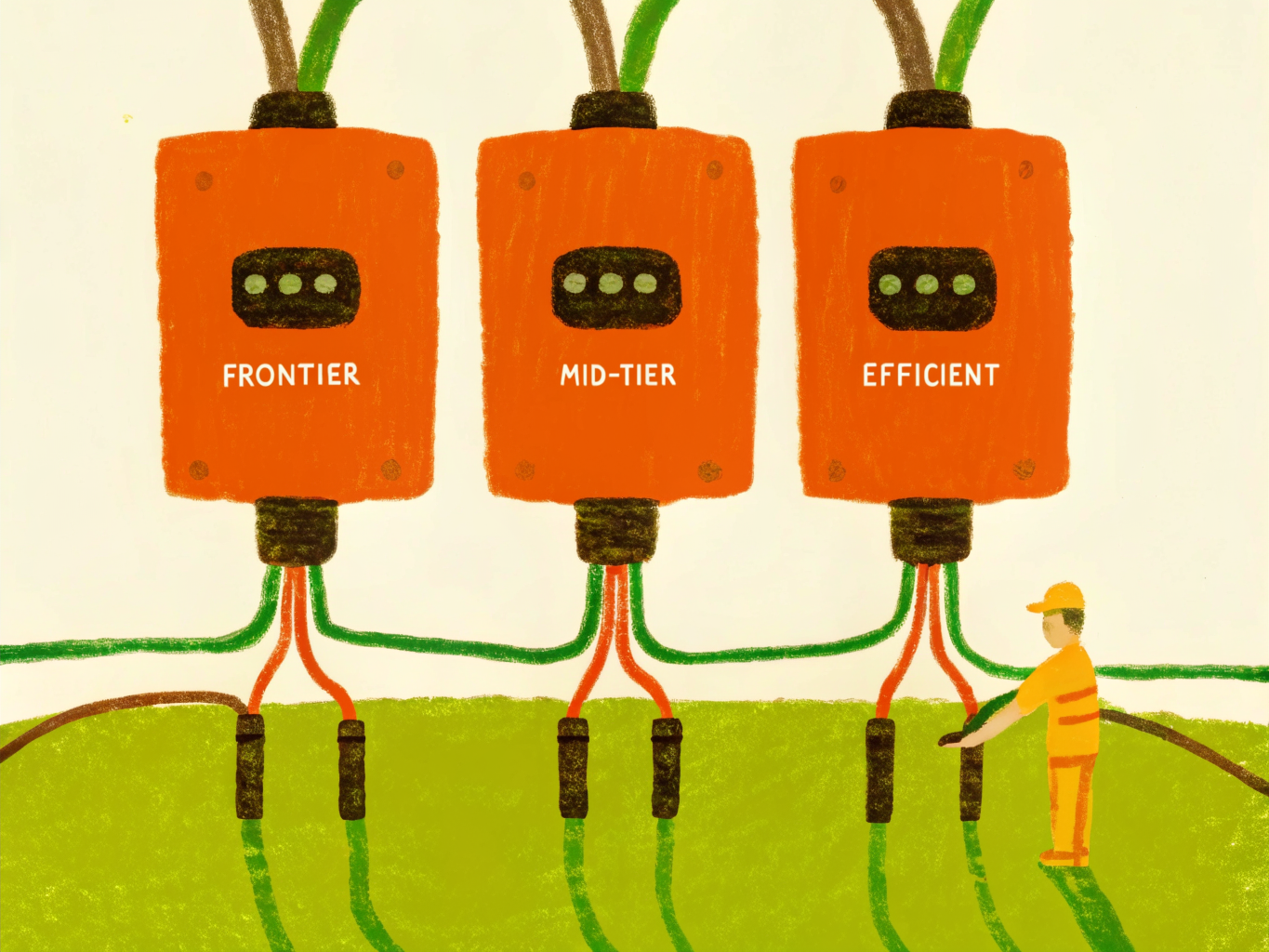
Most enterprise AI teams do not have a usage problem first. They have a routing problem.
When every request goes to the strongest available model, cost becomes detached from task difficulty. A simple extraction task gets priced like a complex reasoning task. A routine rewrite gets priced like a research synthesis.
That works for demos. It does not work for scale.
The hidden multiplier
The expensive part is not just the model price. It is the operational habit that forms around it.
- Teams stop classifying task difficulty.
- Product teams ship with one default model.
- Finance sees aggregate spend but not avoidable spend.
- Engineering teams end up optimizing prompts instead of model allocation.
Once that pattern hardens, every new AI workflow inherits the same cost profile.
Where the savings actually come from
The largest gains usually come from separating work into three buckets:
- Routine tasks that can run on efficient models.
- Mid-complexity tasks that need stronger instruction following.
- High-stakes or high-complexity tasks that deserve frontier models.
That split does not reduce ambition. It reduces waste.
What a useful control layer should do
A useful routing layer should answer a few operational questions clearly:
- Which workflows are defaulting to premium models?
- Which tasks are repeatedly escalated?
- Which workloads could move down a tier with no visible quality loss?
- Which teams are generating cost without clear business value?
If you cannot answer those questions, then your AI budget is being managed reactively.
The next step
The most effective teams stop thinking about AI spend as a single line item. They treat it as an allocation problem that can be designed, measured, and improved over time.
That is where model routing starts to matter.